
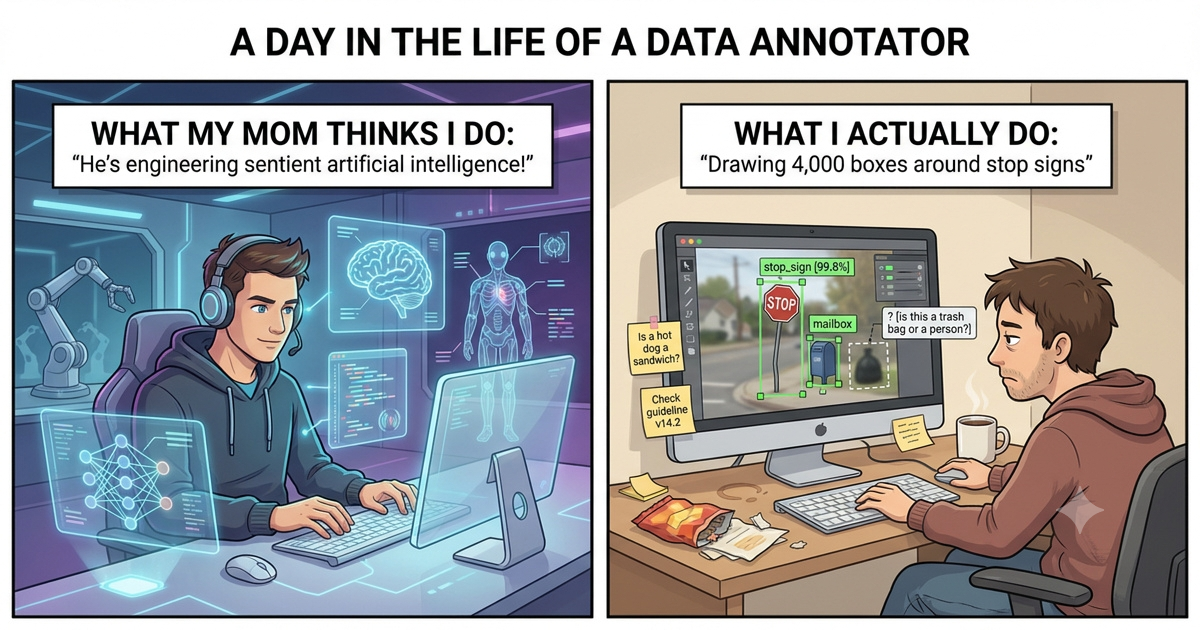
Every Thanksgiving, my mom proudly introduces me to distant relatives with the exact same sentence: “My kid works in Artificial Intelligence.”
Naturally, Aunt Brenda assumes I spend my days in a dimly lit room typing glowing green code into a mainframe, casually teaching sentient robots how to compose symphonies or cure diseases.
Then Aunt Brenda asks what I actually did at work on Tuesday. And I have to look her dead in the eye and say: “I spent six hours drawing tight neon-green rectangles around partially obscured fire hydrants.”
Welcome to data annotation—the glamorous, high-tech backbone of the AI revolution, where we train billion-dollar machine learning models one painstaking pixel at a time.
8:45 AM: Coffee and the Illusion of Simplicity
My day starts with a fresh cup of coffee and a brand-new batch of 2,500 dashcam images. Today’s mission sounds deceptively simple: label every pedestrian, bicycle, traffic_light, and stop_sign.
“Easy,” I think, cracking my knuckles. “I know what a stop sign looks like. I have driven a car. I have eyes.”
This hubris lasts approximately four minutes.
9:12 AM: The Philosophical Crisis Begins
By image #47, reality starts unraveling.
There is a stop sign in the background, except it’s facing completely sideways, partially blocked by a maple tree, and reflected in the side mirror of a parked Honda Civic.
I open the 42-page PDF of client annotation guidelines. Under Section 4.2: Stop Signs, it reads:
“Label all visible stop signs. Do not label reflections unless the sign is also directly visible, in which case label only the physical object. If >60% occluded, apply tag
occluded_heavy.”
I zoom in to 800%. I am now staring at nine blurry red pixels behind a leaf, trying to calculate the exact surface-area percentage of an octagon I cannot see. If I miss it, QA flags my accuracy score. If I box it and the client thinks it’s 61% occluded instead of 59%, QA still flags my accuracy score.
I message the Slack channel: “Hey team, does a sticker of a stop sign on the back of a bumper count as a stop_sign or vehicle_decal?”
Three senior annotators immediately enter a heated 20-minute debate. The client doesn’t reply until Thursday.
11:30 AM: Achieving Flow State (Until the Edge Cases Attack)
Once you survive the morning existential dread, you hit the annotator’s flow state. Lo-fi beats are playing. Keyboard shortcuts are flying. Click-drag, W, click-drag, E, Next Image. You feel like a digital surgeon. You are single-handedly preventing autonomous vehicles from mounting the sidewalk.
Then comes the final boss of every labeling queue: The Ambiguous Blob.
| What Appears on Screen | What It Probably Is | What My Brain Sees After 3 Hours |
| A dark gray silhouette huddled near a curb at dusk | A trash bag waiting for pickup | A crouching pedestrian wearing a puffer jacket |
| A person riding an electric unicycle while carrying a folded scooter | pedestrian + micromobility_device | A cyborg centaur that breaks three separate taxonomy rules |
| A billboard featuring a giant, photorealistic photo of a traffic light | Background noise (ignore) | A trap specifically designed to make a self-driving car slam its brakes on the highway |
I spend ten full minutes zooming in and out on the trash bag. Eventually, I zoom in so far I can see individual JPEG compression artifacts. It’s a Hefty bag. Probably. I tag it ignore and pray to the machine learning gods.
2:15 PM: The Polygon Marathon
After lunch, we switch from bounding boxes to semantic segmentation—the dark arts of data labeling.
Instead of drawing a nice, forgiving rectangle around a car, you must trace the exact silhouette of the car using a polygon tool. Every side mirror, every antenna, every gap between the spokes of the alloy wheels.
If you leave a three-pixel gap of asphalt inside the tire well, your polygon looks sloppy. If you accidentally double-click too early, the polygon closes itself across the middle of the windshield, and you have to hit Ctrl+Z seventeen times while silently weeping.
When my mom asks why my wrist hurts, I tell her it’s from “building neural network infrastructure.” Technically, I’m not lying. Without these 140-point polygons, the neural network thinks the sky is part of the windshield.
4:30 PM: The Guideline Update of Doom
Just as I’m wrapping up my daily quota, a red notification badge pops up in Slack:
@channelQuick update from the client! Going forward, please separatee_bikefrombicycle(you can tell by checking if there is a battery pack mounted on the lower frame). Also, please retroactively update today’s batch! Thanks!!
I stare at my screen. There are 1,400 images in today’s batch. Half of them were taken at dusk in the rain. I am now expected to perform microscopic forensic analysis on bicycle frames from 100 feet away to determine whether a commuter is pedaling with quads or lithium-ion.
I take a deep breath, refill my water bottle, and open image #1.
5:30 PM: Logging Off (And Seeing Boxes Everywhere)
I finally close my laptop and walk outside to get groceries.
This is the side effect nobody warns you about: Annotator Vision. For the first hour after logging off, you cannot look at the real world like a normal human being. I walk down the street mentally drawing green boxes around golden retrievers, assigning occlusion tags to parked delivery vans, and wondering if the guy on the skateboard counts as a pedestrian or a vehicle.
Then my phone rings. It’s my mom.
“Hi honey! Tell me again what you’re working on—I’m telling my book club all about how you’re teaching computers to see!”
I look at a stop sign across the street—clean, unobstructed, bathed in golden-hour sunlight, 0% occluded—and smile.
“Honestly, Mom? Today I saved a bunch of robots from crashing into a trash bag. Pretty big day for science.”
Behind every brilliant AI model is a team of obsessive, detail-loving humans who sweat the small stuff so your engineers don’t have to. Need clean, consistent, audit-ready training data without burning out your internal team? [Let’s talk about your next labeling pipeline.]